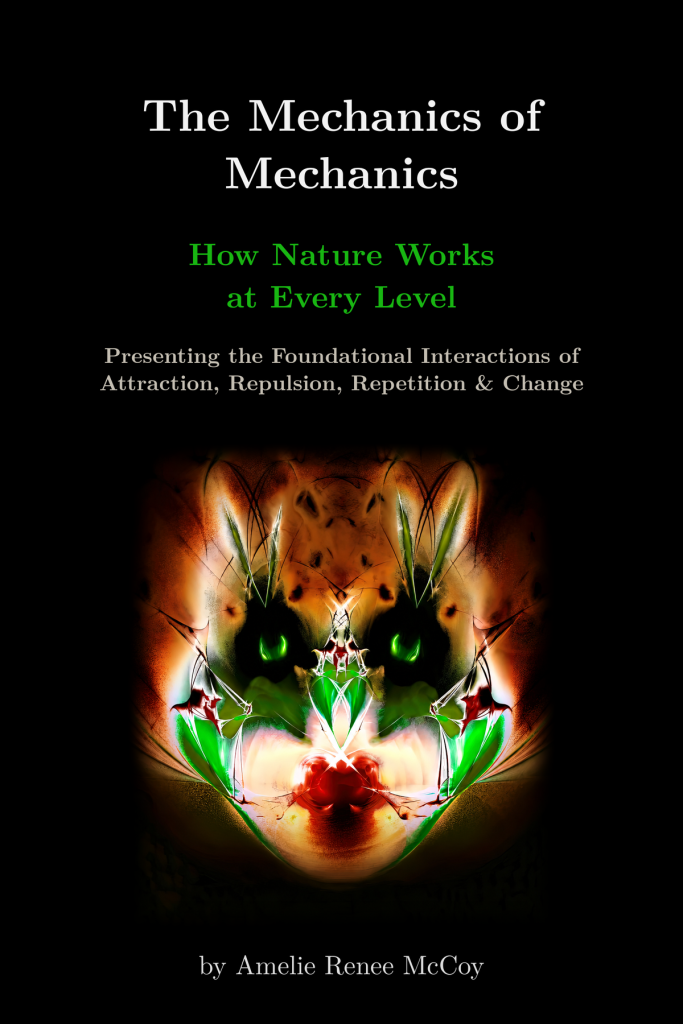
Currently available in English only.
The Mechanics of Mechanics
Free to read. Pay what you wish.
My years of sweat for one hour of your earnings.
If you already understand how Nature works and moves, you don’t need this book.
If you already have Nature’s motions organized and classified according to motion, you don’t need this book.
If you explain Nature by the supernatural, this book will challenge you.
I conceived of it in 1992 because, although I had a bachelor’s degree in University Studies, almost every subject was cordoned off and occupied its own linear space, and there wasn’t much in the way of interdisciplinary studies. You understood your subject as it evolved linearly.
I wanted a method, a way to understand all of Nature in general and specific terms, provided I knew enough about an area to analyze it properly. It took me two years to settle on attraction, repulsion, repetition, and change as my fundamental terms. It took another two years or so to get my first dozen laws, and another 30 years to derive the rest, about two dozen in all, split over The Mechanics of Mechanics and The Mechanics of Gradients. Call me slow, but I had no one else, and the terms themselves were problematic because many people have specific definitions of attraction and repulsion, and my definitions are inclusive of them as nouns, as subject matter, as well as directional motion.
For me, the work and sweat were worth it. I am not lost in the wilderness.
Do I know everything? No, that takes understanding the details of a subject, but I certainly understand nature in broad and specific swaths.
If you are like me, a brother or sister who has sought truth and understanding, these books could be for you.
The Mechanics of Gradients is in final editing, and so is not available yet.
Good luck on your journey.
Amelie Renee McCoy
Get the book: free, or pay what you wish →
What kind of book is this? It is natural philosophy in the old sense, in the tradition of Spinoza, Descartes, and Newton: reasoning from first principles about what we perceive and how nature works. It is not advanced modern physics. There are no equations to work through and no background needed. The laws are built step by step from things you already see every day: what subtracts and draws together, what concentrates and pushes apart, what repeats, and what changes.